

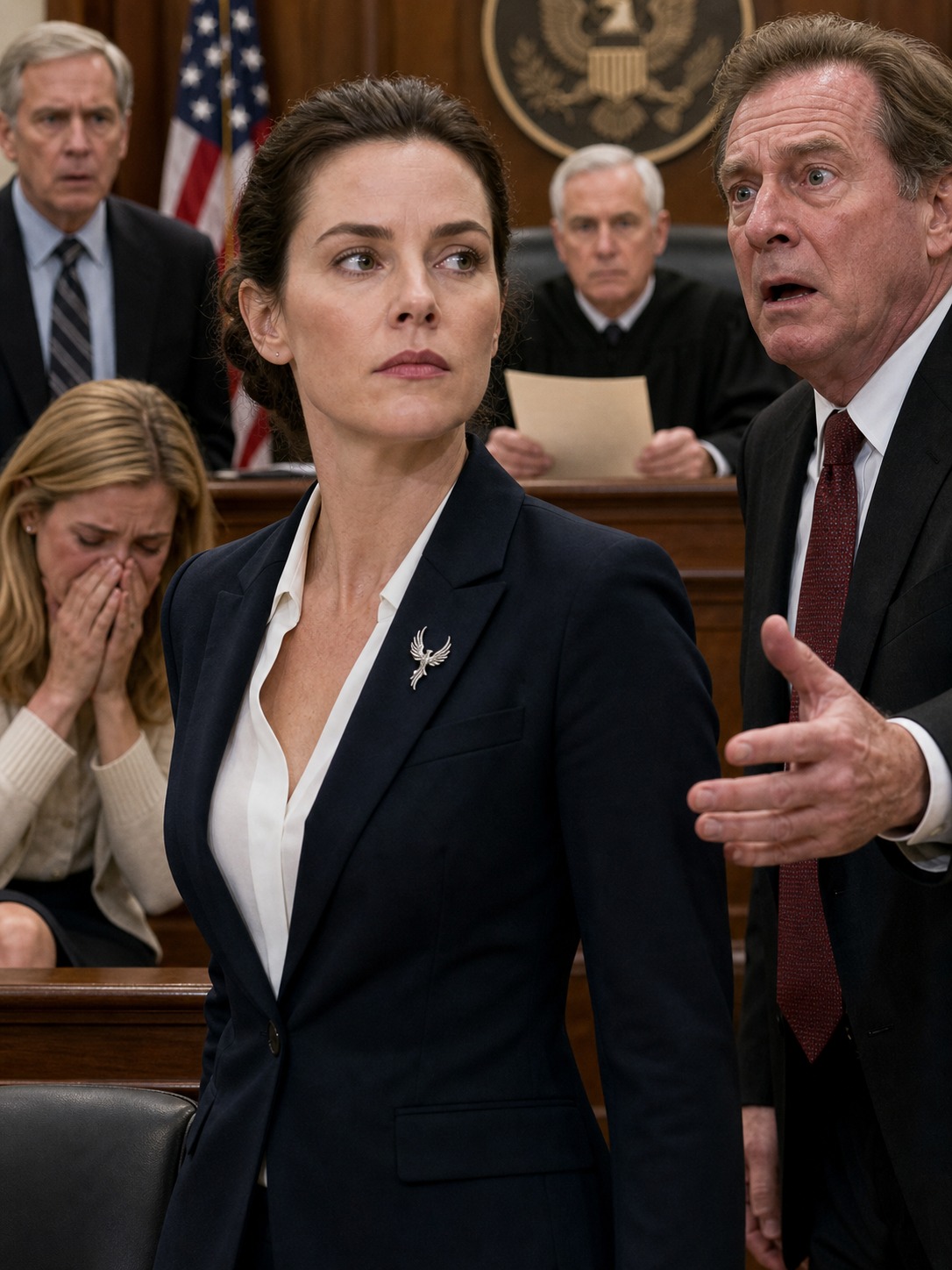
The words landed in the air like a thrown glass.
Nine jurors looked at me. Some with suspicion. Some with pity. One with that particular tightness around the mouth people get when they think they are watching a disgrace unfold in real time.
I did not move.
I did not flinch, did not turn toward the gallery, did not look at my sister, did not give my father the satisfaction of seeing even one muscle in my face betray me. I only reached for the plastic cup of water set on the wooden ledge beside the witness chair and took a measured sip.
The water was lukewarm and metallic, the kind of water that tasted as though it had been sleeping in rusted courthouse pipes since the building first opened in 1974. I swallowed it anyway, placed the cup down without a sound, and folded my hands in my lap.
My name is Elena Vance. I am forty-one years old.
And until nine seconds before my father called me a thief in front of half the town that raised me, I had still been willing to believe there was some part of him that knew exactly who I was.
Now I was watching Robert Vance wave a manila folder at the jury as though it were a battle flag. His face had gone the color of brick dust, his jaw tight, his shoulders squared the way they always were when he was performing outrage for an audience. He had spent most of his life speaking in rooms where people nodded before he finished a sentence. Town council chambers. Church basements. Farm association meetings. Funeral receptions. Courtrooms were new territory for him, but power was not.
The courtroom smelled of old varnish, paper dust, and cheap cologne. Outside the tall windows, Fairfax County moved through an ordinary morning. Cars passed. Phones rang. People bought coffee, missed buses, and complained about traffic. Inside, my family was trying to bury me while I was still breathing.
My father did not know what sat inside the sealed black envelope in my attorney’s briefcase.
Not yet.
I had learned early in life that in the Vance family, silence was not seen as discipline. Silence was guilt. Silence was weakness. Silence was the space other people filled with whatever story benefited them most.
So I sat there, silent, and let him speak.
I let him dismantle twenty years of my life in front of a jury of nine people, most of whom had known his name before they ever knew mine. I let him call me lazy, ungrateful, secretive, unstable. I let him describe a woman I barely recognized, a phantom daughter who drifted from couch to couch in Washington, D.C., living off scraps from her mother’s generosity until, in his telling, even death had not stopped me from taking more.
He was not merely my father in that courtroom. Not in his mind.
He was Robert Vance, the king of our little county. The man who had run the local council for three decades, whose opinions shaped land permits, school board appointments, road repairs, and reputations. He was the man who decided which families were “solid” and which ones were “trouble.” The man who could ruin a young contractor’s business with one sentence over coffee at Mason’s Diner. The man who believed public respectability was a kind of birthright and that obedience was the proper form of love.
To him, I was the daughter who ran away.
The eldest child who left the farm after college, enlisted through ROTC, moved into government work, and refused to come home long enough to be folded back into the family machinery. The girl who chose windowless offices, classified briefings, and the anonymity of Washington over Sunday dinners where my father handed out verdicts like scripture.
“She is a ghost,” Robert told the jury, his voice booming with that false authority he used to dominate every room he entered. “Ask anyone in our town. Ask the neighbors. Ask the people who knew her mother. Elena hasn’t been seen in fifteen years except when she appears for a funeral or holiday, standing in the corner like she’s too good for us. She says she works for some logistics group, but there is no office. There is no real company website. My investigators found nothing but a blank space where a career should be.”
He turned slightly so the jury could see his profile, his grief, his righteous anger. He had practiced this.
“She has spent her life living off whatever scraps her mother threw her,” he continued. “And now that my wife is gone, she wants to bleed us dry.”
I glanced once at my sister Ashley.
She sat in the gallery with her hands clasped in her lap, wearing a pale designer cardigan I knew I had paid for three years earlier through a discreet gift fund set up in her name. Her eyes were cast downward, lashes wet, mouth trembling at all the right moments. Ashley had always been good at looking delicate. Seven years younger than me, she had built an entire identity around being the one who stayed. The sweet daughter. The helper. The teacher. The one who knew which casserole dish belonged to which church lady and which neighbor needed a ride after cataract surgery.
Robert had spent months whispering in her ear, feeding her the story that I was a parasite, that I had manipulated our mother, that I had hidden myself because I had something to hide. Ashley had swallowed it whole.
Or at least she had swallowed the version that came with a larger share of the inheritance.
Inside me, the anger was not hot. It did not burn or pulse or surge.
It became cold. Precise. Clinical.
It was the same detached focus I used when coordinating extraction teams through unstable territory. The same calm that settled over me when a convoy went dark, when a satellite feed cut out, when a source’s last transmission ended mid-sentence and every person in the room looked toward me for the next move.
I stared at the back wall of the courtroom and realized they had truly erased me.
Not ignored me. Not misunderstood me. Erased me.
After my mother’s funeral, I had gone back to the farmhouse alone. The hallway still smelled faintly of lemon oil and the lavender sachets she kept tucked into drawers. I remember standing beneath the staircase and looking at the long wall where family photographs had always hung.
My university honors were gone. My ROTC commissioning portrait was gone. The framed newspaper clipping from the scholarship banquet was gone. Even the photo of me at nineteen, sunburned and grinning on the hood of the old pickup after I had spent ten hours helping repair the east fence, had vanished.
In their place hung a cheap tractor dealership calendar, a faded print of a fox hunt, and a photograph of Ashley with her students on field day.
Where I had been, there was only a pale rectangle on the wallpaper.
That was the validation gap: the hollow ache that opens inside you when the people who raised you decide your worth is zero because they cannot understand the shape of your life. When they look at absence and call it failure. When they mistake secrecy for shame because they cannot imagine a kind of work that does not require applause.
“Miss Vance.”
Gerald Davis, my father’s attorney, approached the witness box with a smirk polished smooth by years of local victories. He was a tall man with silver hair, a silk tie, and the kind of courtroom manner that relied less on intelligence than on intimidation. He held a sheet of paper between two fingers as though it smelled unpleasant.
“Can you provide this court with a single verifiable piece of evidence that you have held gainful employment at any point in the last decade?” he asked. “A paystub? A tax return? A company directory? A supervisor? Anything that isn’t a shadow?”
I looked at him.
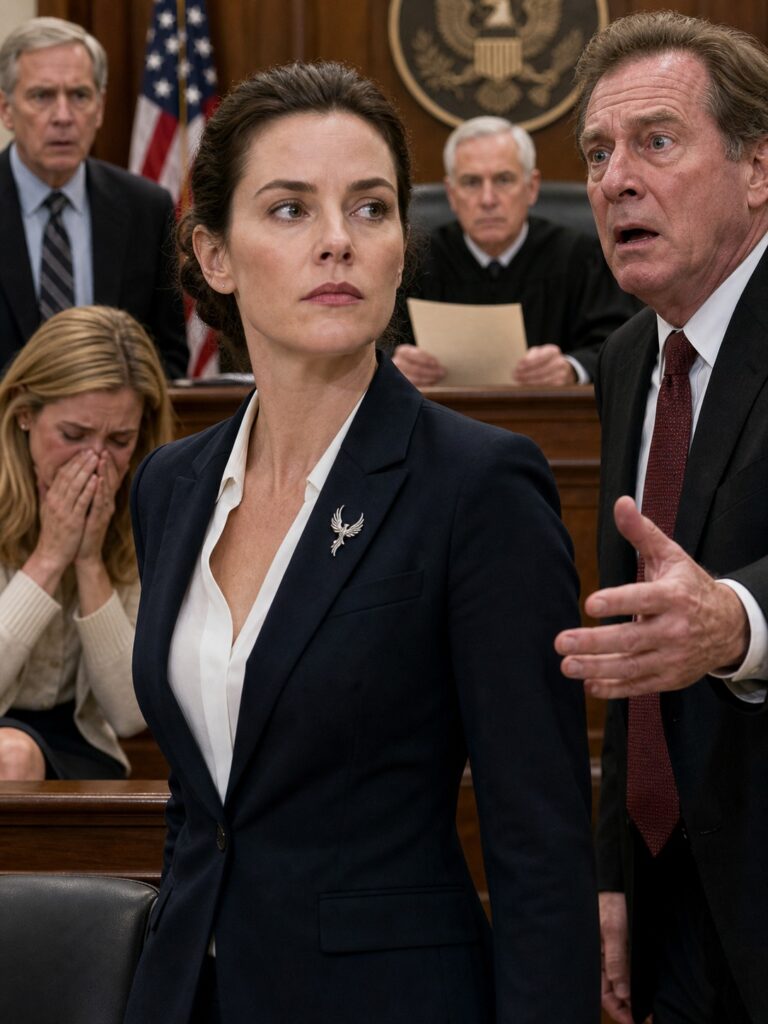
Then I looked at my father.
Robert was leaning back in his chair, arms folded, wearing that smug half-smile I had known since childhood. The smile that said he had already decided the outcome and was merely waiting for everyone else to catch up.
“I work in operations analysis,” I said.
My voice was level. Quiet. Dangerous, if one knew what to listen for.
“My clients value discretion. The records exist. Your lack of access to them is not my failure. It is your limitation.”
A ripple moved through the courtroom.
Robert barked out a laugh, sharp and mocking.
“Discretion?” he said. “You were a paper pusher, Elena. A glorified clerk. Don’t dress up laziness with big words.”
I felt the silver phoenix pin pressing lightly against the fabric of my blazer. I had almost not worn it. It was small, subtle, and meaningless to most people—nothing more than a polished silver bird with wings curved upward. To those who knew, it was not jewelry. It was a marker. A recognition. A symbol awarded to people who had spent their careers moving through the gray corridors between what the public could know and what the world required someone to do.
My father had no idea that while he was complaining about feed prices at Mason’s Diner, I was sitting in secure facilities at Langley, reviewing intelligence streams that shaped decisions made at levels he could not even imagine.
He had no idea that while he mocked my “generic office job,” I had coordinated movements of assets across continents, negotiated quiet evacuations under collapsing governments, and signed off on operations that would never appear in history books but had prevented families like ours from waking up to a very different country.
I had spent fifteen years in the shadows accepting their insults because the alternative was a breach of national security.
Fifteen years of shrugging off “Still between jobs, Elena?” at Thanksgiving.
Fifteen years of Ashley saying, “It must be nice to have so much free time,” while wearing the earrings I had anonymously paid for.
Fifteen years of Robert telling neighbors that I did “something vague in D.C.” with the same tone he would use to describe a stain on the carpet.
That was the cost of silence. We used that phrase in the agency more often than people might think. It did not mean keeping quiet because you were afraid. It meant accepting that if you were good at certain kinds of work, no one would ever clap for you. No parade. No plaque. No framed certificate above the fireplace. You got a gray room, a secure line, and sometimes a family who thought you were a failure because you could not show them the trophy they demanded.
They had no idea that for years I had been the invisible architecture holding parts of their lives together.
When the farm’s irrigation system failed in 2018 and Robert faced a six-figure loss that could have pushed him into selling acreage he claimed had been in the family since the Civil War, he thought he had caught a lucky break through a private agricultural grant.
It was not luck.
It was $136,000 of my hazard and combat pay routed through three shell companies I built for the sole purpose of preserving his pride. I knew he would rather lose everything than take money from a daughter he had already dismissed, so I let him believe some anonymous grant committee had found him deserving.
When Ashley wanted a master’s degree she could not afford, she cried to our mother about loans and sacrifice. A month later, an alumni scholarship appeared.
That was me.
When my mother’s insurance denied coverage for experimental treatments during the last ugly stretch of her illness, Robert said strangers in the house made him uncomfortable and private nurses were “a waste when family could help.”
Family did help.
I paid for the nurses. I arranged the billing. I signed authorizations from hotel rooms, field offices, and once from the back of an armored vehicle while a translator argued with a checkpoint commander twenty yards away.
I had been the ghost in their bank accounts. The invisible hand they cursed while reaching for the stability it provided.
And now they were using the very secrecy I maintained to protect my country, and them, as a weapon to destroy me.
“Tell us, Elena,” Gerald Davis said, moving closer. His breath smelled faintly of stale coffee and courtroom confidence. “Since you are so successful in this mysterious office of yours, why did your mother feel the need to include an active employment clause in her trust? Was it because she knew her eldest daughter was a drifter? A woman who preferred the shadows of D.C. to the honest work of a farm?”
The jury watched me.
In places like ours, “honest work” meant sunburned necks, calloused palms, and waking before dawn to wrestle a machine older than your children. It did not mean sitting inside a SCIF at Fort Meade analyzing intercept logs while a dozen agencies waited for your assessment. It did not mean flying under false itineraries, sleeping with a go-bag near the door, or learning how to keep your face empty when someone said the name of a city where people you knew had just died.
“My mother understood the nature of my work better than anyone in this room,” I said. “She knew my life required discretion. She built that clause not to punish me, but to protect the trust from people who might one day try to claim I wasn’t contributing to society simply because they could not see the evidence on a public database.”
Robert laughed again, but it sounded thinner this time.
“Contributing to society?” he scoffed. “You sat at a desk. You pushed paper. Your sister stayed here and actually cared for this family. Don’t make yourself a martyr because you’re tired of being hungry.”
Something shifted inside me then.
Not anger.
Recognition.
This was never about whether he believed I had worked. Not really. It was about control. About the old humiliation of having a daughter who refused to orbit him. A daughter he could not explain, categorize, or diminish enough to make himself comfortable.
“This isn’t about the money, is it, Robert?” I asked.
I did not call him Dad.
The omission struck harder than I expected. Even Judge Miller lifted his eyes.
Robert’s face darkened. “You don’t get to—”
“This is about control,” I continued. “You couldn’t control where I went, so you decided to rewrite where I’ve been.”
“I am showing the world who you really are,” he snapped, half rising from his seat.
I leaned forward just enough that only the front rows could feel the edge in my voice.
“Be careful when you go looking for truth in the dark,” I said. “You may not like what looks back.”
Gerald Davis did not like that answer. He adjusted his tie as though resetting himself physically might restore the balance of power.
“The defense speaks in riddles,” he said, turning back to the jury. “Shadows. Secrets. Limitations. But facts do not hide behind poetic language. We have a report from a licensed professional investigator. No North Atlantic Logistics Group exists at the listed address on the defendant’s filings. The supposed office is a postal box at a UPS store. There is no corporate health plan tied to Miss Vance. No public professional profile. No LinkedIn. No company directory. No website beyond a placeholder page registered through a privacy shield.”
He paused, letting the absence become accusation.
“The truth is far simpler,” he said. “Elena Vance is a ghost because she has nothing to show.”
Then he turned toward the gallery.
“Ashley Vance, would you please step forward?”
My sister stood.
She moved to the witness stand as though every step cost her something. The performance was exquisite. Her shoulders curved inward. Her fingers trembled. Her eyes were red-rimmed. She looked not like an accomplice, but like someone forced into a terrible duty by conscience.
The oath was administered. Ashley sat. She looked at the jury the way she looked at parents during school conferences—soft, earnest, calibrated to be trusted.
“Elena always had a way of making us feel small,” Ashley said, her voice barely above a whisper. “She would disappear for months, then come back and talk about big contracts and important people, but never in a way anyone could verify. She made it seem like we were ignorant for asking normal questions. And whenever Mom needed help with the mortgage or medical bills, it was always me here in the house. Elena would just say she was between cycles or that things were complicated.”
My hands remained still in my lap.
“After Mom passed,” Ashley continued, swallowing hard, “I found bank statements. Thousands of dollars withdrawn from Mom’s personal accounts. Signatures that didn’t look like hers. Dates when Mom was too sick to understand what she was signing. It broke my heart to realize my big sister might have used our mother’s dementia to fund her important life in D.C.”
A chill moved through me.
Forgery.
They were going for forgery.
Not merely laziness. Not merely failure to satisfy the employment clause. Criminal fraud. Elder exploitation. Theft from a dying woman.
Ashley did not mention the private nurses. She did not mention the medical equipment. She did not mention the transport specialist I hired when Mom needed to be moved between facilities and Robert insisted he could “handle it himself” despite not knowing how to lift her safely. She did not mention the reimbursements approved by Mom while she was still lucid, while she still squeezed my hand and whispered, “Don’t tell your father. He’ll make your help into an insult.”
Robert sat behind his lawyer, nodding solemnly.
He looked like a man who had already won.
He had spent decades building a cathedral of lies in our town, and now he was placing the final stone.
“Your Honor,” Gerald Davis said, standing taller, his voice swelling into theatrical gravity, “we move to enter Exhibit Twelve. A comprehensive background investigation, banking irregularity analysis, and sworn statement from a forensic document examiner suggesting that signatures on trust-related withdrawals were fraudulent. It is clear Miss Vance has not only failed the active employment clause, but actively defrauded the estate to maintain a lifestyle she never earned.”
The jury turned colder.
I saw it happen. Their faces hardened. Their sympathy moved away from me like sunlight leaving a field. I was no longer merely the absent daughter. I was the city woman who stole from the dead.
But I did not reach for my attorney’s hand.
I did not look at Robert.
I looked at the courtroom door, then back at Gerald Davis.
“Is that all?” I asked quietly.
Robert shot forward in his chair.
“Is that all?” he barked. “You’ve been caught, Elena. You’re a thief and a liar.”
“Mr. Vance,” Judge Miller warned, “sit down.”
But his tone was distracted.
The judge was staring at my lapel.
Not at my face. Not at the file. At the silver phoenix pin.
For the first time since the trial began, Judge Thomas Miller looked less like a weary county judge and more like a man remembering a briefing room.
My attorney, Marcus Thorne, rose beside me.
Marcus was not local. He did not wear charm like cologne or perform outrage for juries. He had spent twenty years in the JAG Corps before entering private practice for specialized clients with complicated lives and sealed records. He wore his suit like armor and spoke only when speech could change the battlefield.
He opened his briefcase.
The sound of the latch was small, but the room seemed to hear it as thunder.
“Your Honor,” Marcus said, his voice calm and resonant, “the plaintiff’s investigation was thorough by civilian standards. Unfortunately, it was designed to locate a person who, for reasons of national security, is not permitted to exist in ordinary public databases.”
Gerald Davis frowned. “Objection. This is—”
“Sit down, Mr. Davis,” Judge Miller said.
The attorney froze.
Marcus reached into the briefcase and withdrew a single black envelope. Heavy stock. Wax sealed. The embossed gold eagle of the Office of the Director of National Intelligence caught the fluorescent light.
Several people in the courtroom leaned forward without realizing it.
“Since the plaintiff has raised allegations of criminal fraud,” Marcus continued, “my client has been granted a limited waiver under Title 10 provisions and related interagency authorization. We move to introduce a verified statement of service and employment status, pre-cleared for judicial review.”
For the first time that morning, Robert did not look certain.
His smirk flickered.
Gerald Davis stepped toward the bench, squinting at the envelope.
“What is that?” he demanded. “ODNI? Your Honor, this is a trust dispute. This has nothing to do with—”
“It has everything to do with it,” Marcus said.
The room changed.
I have been in rooms when a drone feed went black. I have heard the silence after a commander receives confirmation that rescue is no longer possible. I know the particular weight that falls when everyone realizes the event they thought they were witnessing was only the surface of something much larger.
That weight entered the courtroom now.
Judge Miller leaned back slowly. His eyes remained fixed on the envelope.
“Counselor,” he said, voice low, “you are asserting that this document contains information classified under national security protections.”
“I am, Your Honor,” Marcus replied. “Furthermore, the Office of General Counsel for the Central Intelligence Agency has authorized a limited disclosure to this court. It confirms the defendant’s continuous active employment for the past fifteen years. It also clarifies the nature of North Atlantic Logistics Group.”
Robert stood so quickly his chair screeched against the floor.
“This is a stunt,” he said. “She’s a clerk. She told us she was an analyst. I’ve seen her apartment. I’ve seen her life. She’s nobody.”
“Sit down, Mr. Vance,” Judge Miller barked.
This time, there was no softness in him.
Robert sat.
The judge accepted the envelope. He reached for a silver letter opener and broke the seal with slow, deliberate care. The courtroom was so quiet I could hear the fluorescent lights humming overhead. Somewhere behind me, someone’s bracelet clicked faintly as she shifted her hands. Ashley had gone pale. Gerald Davis stood frozen, caught between objection and dread.
Judge Miller removed the document.
He read it once.
Then he read it again.
I counted the seconds because counting is what you do when part of you wants to leave your body.
One.
Two.
Three.
Four.
He removed his glasses and set them on the bench.
When he looked up, his face had changed completely. The tiredness was gone. The local familiarity was gone. What remained was the face of an officer who had just recognized a battlefield.
“Mr. Davis,” he said, and his voice had acquired a new and terrible weight, “you have built a case on the premise that Elena Vance is a ghost. You have accused her of fraud, theft, laziness, and exploitation of her late mother.”
He paused.
His gaze shifted to my father.
“I have before me a verified statement of service from the Director of National Intelligence. It confirms that Elena Vance holds the rank of Senior Intelligence Service Level Four. For the last decade and a half, she has served as a Director of Operations for the Central Intelligence Agency.”
The courtroom did not simply go quiet.
It went cold.
Robert’s mouth opened.
No sound came out.
Ashley made a small strangled noise, as if the air had been knocked out of her. Gerald Davis stared at Judge Miller with the horrified stillness of a man watching his career walk toward a cliff.
Judge Miller continued.
“The entity referred to as North Atlantic Logistics Group is a Tier One cover designation established through Department of Defense channels and recognized by authorized federal agencies. The absence of public employment records is not evidence of Miss Vance’s failure. It is evidence of a protected operational structure. The blank spaces in her record are not proof of idleness. They are proof that the system worked.”
His eyes flashed.
“She was not hiding in Washington, Mr. Vance. She was serving her country in a capacity this court will not further disclose.”
I kept my eyes forward, but something inside me loosened.
For twenty-one years, I had felt unseen by the people whose recognition I had once wanted most. I had told myself I was too old, too trained, too disciplined to care. But when Judge Miller looked at me, not with pity, not with suspicion, but with the grave acknowledgment of someone who understood the cost, I felt the ache of those years rise sharp behind my ribs.
For the first time in a long time, someone in my father’s world had seen me clearly.
“Bailiff,” Judge Miller said, “secure the doors. No one leaves this room until instructed. We are shifting briefly to an in-camera proceeding to address the classified nature of what has been introduced. Mr. Davis, I suggest you begin thinking very carefully about a prompt withdrawal of this complaint.”
Robert tried to speak. His voice cracked.
“She… she was just an analyst,” he said. “She told us she was an analyst.”
I turned my head and looked at him.
“I told you what you were cleared to know, Robert,” I said. “You weren’t asking questions because you wanted to know me. You accepted the answers because they fit the story you wanted to tell.”
The silence that followed was different from the silence before.
Earlier, it had pressed against me. Now it pressed against him.
Robert Vance looked like a man carved from stone and left in the rain for years. The authority drained first from his posture, then from his face. His hands—those broad, calloused hands that had pointed, dismissed, and commanded all my life—trembled on the edge of the table.
Gerald Davis did not object again.
He knew the battlefield had changed, and he had marched his client straight into artillery.
What followed happened quickly, though every second felt sharpened.
The jury was excused under strict instruction. The courtroom was sealed for a limited judicial review. Marcus presented only what had been authorized: confirmation of my employment status, rank, and continuous service; confirmation that my records were intentionally shielded; confirmation that my mother’s trust clause had been drafted with knowledge of that shielding and with specific language meant to prevent exactly this kind of bad-faith challenge.
Then came the banking records.
Not the ones Gerald Davis had selected and framed like evidence of theft.
The real ones.
Authorizations. Medical invoices. Private nursing schedules. Reimbursement agreements. A notarized statement from my mother, signed while fully competent, explaining that certain disbursements were to repay me for care expenses I had covered privately because Robert “would treat help as humiliation and refuse what I need.”
My mother’s words entered the courtroom like a final witness.
Robert stared at the page when Marcus read the relevant lines aloud. For a moment, something passed over his face that might have been grief if grief had not spent so many years hardening into pride.
Ashley cried silently.
I did not know whether she cried from shame, fear, or the collapse of her expected inheritance.
Perhaps all three.
Judge Miller leaned forward at last, hands clasped on the bench.
“I am dismissing this complaint with prejudice,” he said. “The plaintiff’s allegations were not merely unsupported; they were reckless, defamatory, and pursued after ample opportunity to verify the relevant facts through proper channels. The court is issuing sanctions against the plaintiff in the amount of forty-five thousand two hundred dollars for legal fees and administrative burden placed upon federal entities by this proceeding.”
Robert’s head snapped up.
“Furthermore,” Judge Miller continued, “I am awarding the defendant fifty thousand dollars in damages for defamation of character, to be paid immediately from Mr. Vance’s personal share of the family estate.”
Robert’s mouth moved.
No words came.
He looked at Ashley, but she had turned away from him, face buried in her hands. The alliance of convenience shattered the moment consequence entered the room. It had been easy for them to stand together when I was the villain and the prize was money. It was something else entirely to stand beside the lie when the lie began sending invoices.
“Elena,” Robert finally croaked. “We didn’t know.”
I stood.
The old Elena might have argued. The little girl in me might have begged him to understand, might have opened every wound and laid every sacrifice at his feet, hoping he would finally kneel beside them and call them worthy.
But that girl had spent too many years waiting outside locked doors.
“You weren’t supposed to know the details,” I said. “But you were supposed to know me.”
His face twisted.
“You were supposed to know that the daughter who worked ten-hour days in the fields as a child did not become a leech because she moved to a different city. You were supposed to know that silence is not the same as failure. You were supposed to know that your child deserved more than suspicion when you did not understand her life.”
I stepped down from the witness box.
My heels sounded too loud on the polished wood.
As I passed Ashley, she lifted her head.
“Elena,” she whispered.
I stopped for half a second.
There was a time when I had braided her hair before school because Mom was already in the fields and Robert had no patience for ribbons. A time when she followed me down rows of corn, asking questions about everything, believing I knew the answer because I was older and tall enough to reach the high shelves. A time when I would have burned the world down to protect her.
But that was before she sat in a courtroom and called me a thief.
“Not today,” I said.
Then I continued walking.
Robert rose unsteadily as I approached the aisle.
“Elena, please.”
I paused beside him but did not turn fully.
“The money for the nurses,” I said quietly. “That was me. The anonymous scholarship for Ashley’s graduate degree was me. The hundred and thirty-six thousand dollars that saved the farm four years ago—that was me too.”
His eyes widened, horror dawning too late to be useful.
“I did not do it because I loved the legacy,” I said. “I did it because my mother loved you. But that debt is officially settled.”
I left him standing there in the ruins of his certainty.
The heavy oak doors opened before me, and I stepped into the marble hallway of the Fairfax County Courthouse.
The air outside the courtroom felt different. Cooler. Cleaner. It tasted faintly of floor polish, filtered ventilation, and freedom. For a moment I stood beneath the high ceiling and let the quiet settle around me. Not the silence of secrecy. Not the silence of being misjudged. A silence I had chosen.
Marcus Thorne caught up with me near the elevator.
He did not say congratulations. People in our line of work rarely use that word after survival. He simply handed me my briefcase and adjusted his cuff.
“The director wants a debrief at 0800 tomorrow,” he said. “He was impressed by your judicial restraint.”
“I was balancing the books,” I replied.
Marcus gave the smallest smile. “Efficiently.”
The elevator doors opened.
We stepped inside, and for the first time all morning, I saw my reflection in the polished metal. Dark blazer. White blouse. Controlled expression. Silver phoenix pin catching light above my heart.
How many years had I made myself smaller?
How many years had I let people mistake restraint for emptiness because correcting them would cost too much?
I thought of my mother then. Not as she had been at the end, fragile and fading beneath hospital blankets, but as she was when I was young—standing in the kitchen at dawn with flour on her hands, listening carefully while I talked about scholarships, flight paths, military service, places beyond the county line. She had been the first person to understand that leaving was not abandonment. Sometimes leaving was the only way to become large enough to protect what mattered.
She had known enough to build protection into the trust. She had known Robert might one day turn my absence into accusation. Even dying, she had tried to leave behind a shield.
The elevator descended.
When the doors opened, Marcus went toward the side exit to take a call. I walked alone through the lobby and out into the parking lot.
The sun had climbed higher, bright against windshields and courthouse stone. People moved around me with folders tucked under their arms, coffee cups in hand, phones pressed to ears. Ordinary lives. Public lives. Lives with visible proof.
I found my car at the far end of the lot.
For several seconds, I sat in the driver’s seat without starting the engine. The courthouse rose in the rearview mirror, square and pale against the sky. Somewhere inside, Robert was likely still sitting at counsel table, trying to reconcile the daughter he had invented with the woman the court had just recognized.
I reached up and unclipped the silver phoenix pin from my lapel.
It lay in my palm, small and cool.
To my father, it had been decoration. To Judge Miller, it had been a language. To me, it was a reminder of all the times I had turned ash into movement and called it duty.
I placed it carefully in its velvet-lined box.
For fifteen years, I had been a ghost in my own family’s story. An absence they filled with resentment. A blank space they mistook for failure. I had allowed it because I believed service required sacrifice, and sometimes it does.
But there is a difference between sacrifice and surrender.
As I started the car and pulled out of the courthouse lot, the road ahead curved toward the highway, toward Langley, toward another gray room and another sealed file and another day of work most people would never know existed.
Behind me were the farmhouse walls where my portraits no longer hung. The father who confused control with love. The sister who had chosen inheritance over loyalty. The town that would spend the next month whispering, revising, pretending it had never doubted me quite so loudly.
Ahead of me was the life I had built without their permission.
The morning sun flashed over the windshield, and I felt something inside me settle—not soften, exactly, but align.
I was no longer waiting to be validated by people committed to misunderstanding me.
I was no longer a ghost in my own story.
I was the author.
And from that day forward, anyone who wanted to speak my name would have to tell the truth or choke on the silence.


0 commentaires:
Enregistrer un commentaire